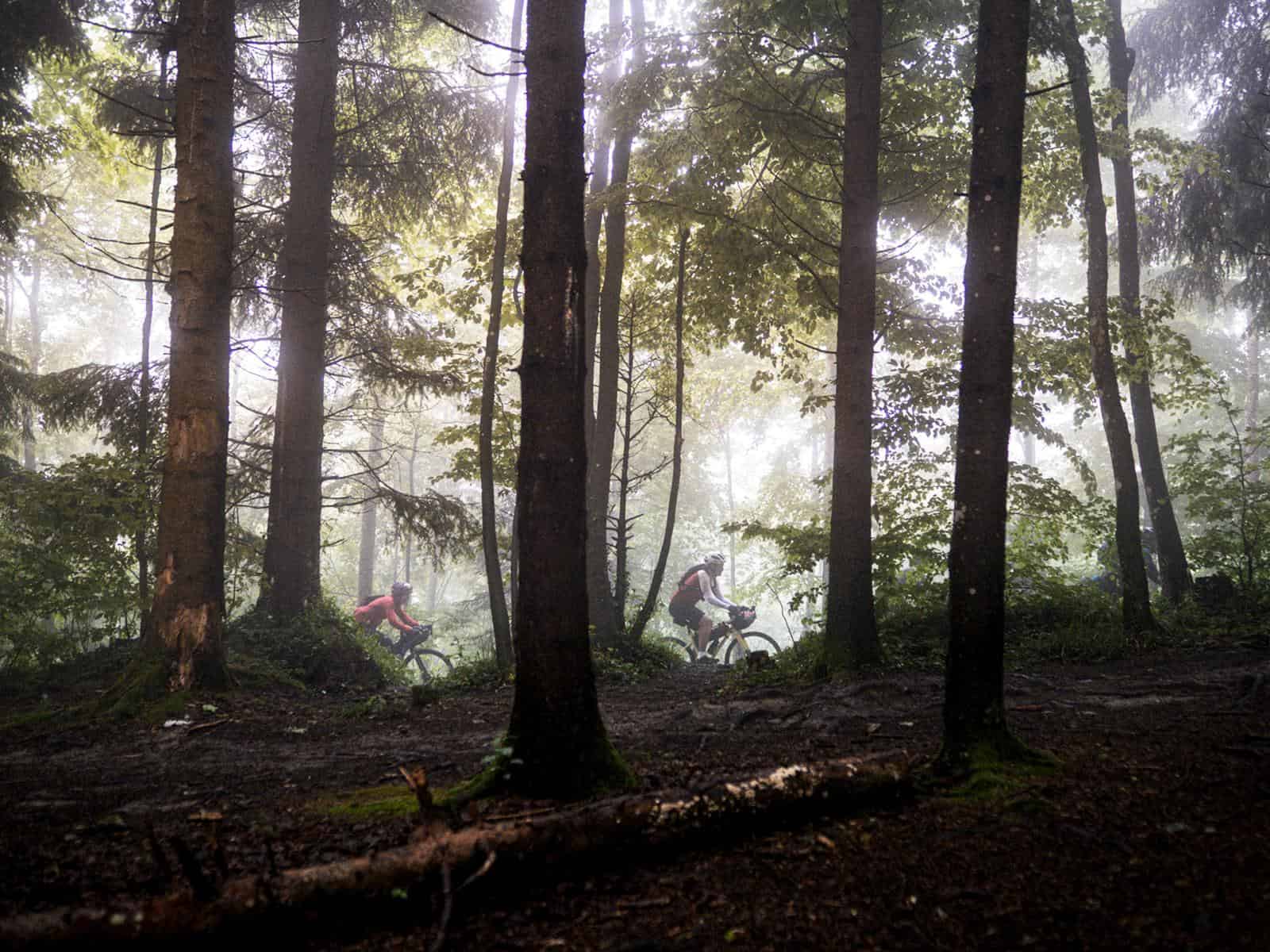
Stories from Züri Escape: surveying fails, cemeteries on AirBnB, and Kierkegaard
Short stories from the field: people, places, and cemeteries, with some reflections on all this.
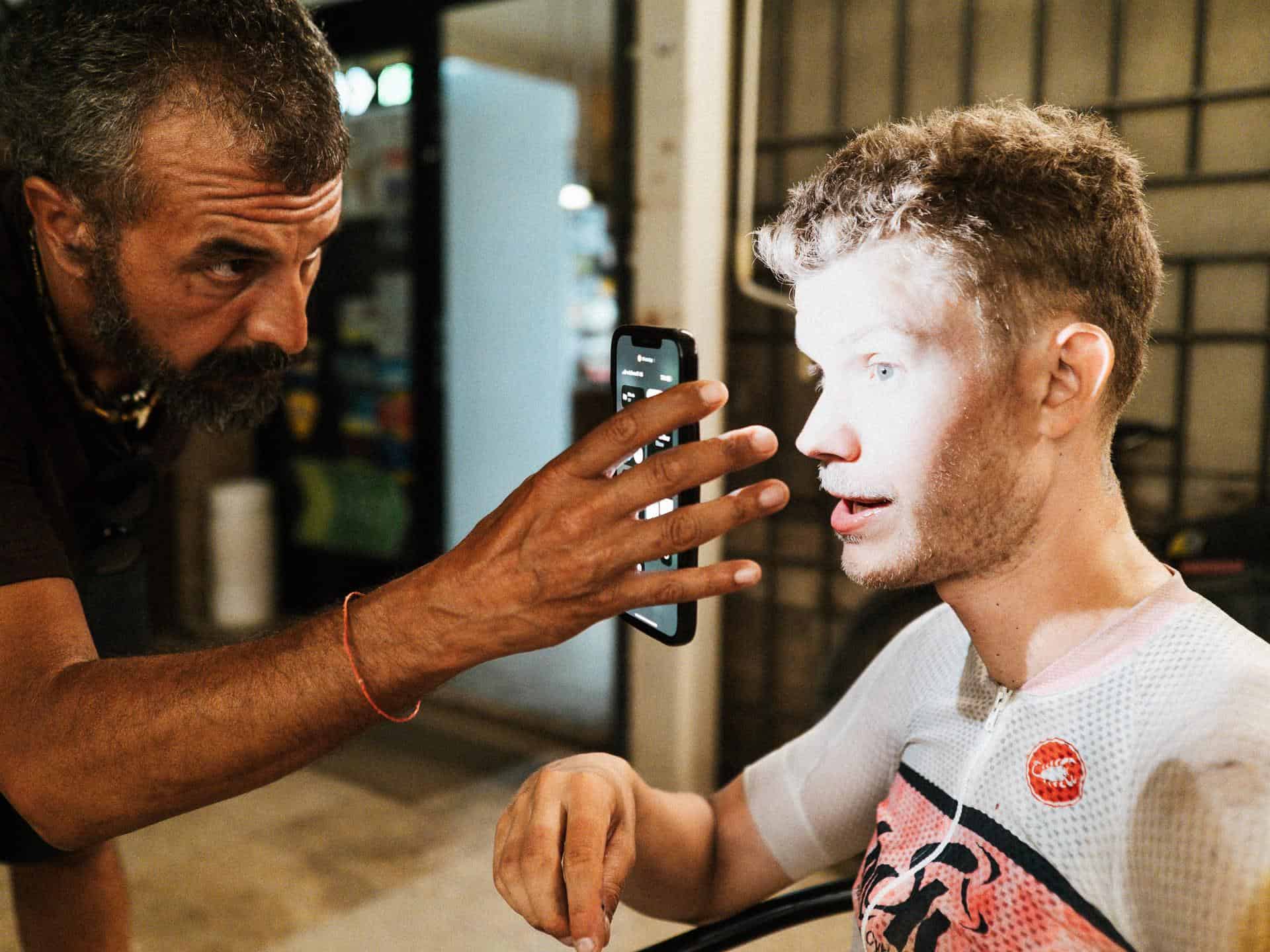
It’s over. Just before midnight, in Amerongen, Marco, Francesco and I hit the road one last time, headed home. In the last two weeks we drove 9,500km, starting from Giovinazzo in southern Italy and across central Europe: Austria, Germany, France, Switzerland, a glimpse of Slovenia, and the Netherlands. We chased the 100+ riders who took part in chapter II of VIA Race, an unsupported, free-routing, road 4,000km race.
Marco took care of videos, while Francesco managed social media. I was the photographer in charge of the overall media plan. Sophie, Patrick, and Elias were also in the game in different locations.
This is, in part, history repeating: in summer 2024, I covered the second half of VIA chapter I alongside Ryan le Garrec, driving a tiny car loaded with our gear and our bikes. The first chapter started in Southern Spain and reached Giovinazzo, following Hannibal’s march against Rome across the Pyrenees and the Alps. The second started in the same town and headed North, along Germanicus’ route — a race inspired by history and conceived to provide adventure to all participants.
It is always exciting to witness history, no matter how small. Documenting so many stories along the road has been even more interesting and rewarding, but also complex to assimilate. Each story has its own meaning to the rider, and a different meaning to us photographers and videomakers; each situation stirs a new reflection on the nature of unsupported races. Each photo opportunity presents its own challenges: sometimes it’s very hard to find the rider; other times, the story implies ethical dilemmas.
What follows is a series of reflections inspired by two years of VIA coverage, plus other shorter races such as Three Peaks and various Cake Movement events — very different in kind, which makes them perfect for exploring the many challenges of ultracycling coverage. It’s also the closest thing I have to a self-evaluation process: thinking and writing about it allows me to clear my mind about my role as a photographer in this specific niche.
I am always thankful to the riders for sharing their stories with us at each event. When it comes to VIA, from start to finish, and even more so from chapter I to II, I witnessed the growth of a new community, bound together in adventure and personal challenge. We caught tales of adventure, joy, struggle, regret, and sharing. Adam, for example. But also Eivind. And Joanna. Fiona. Rafa. Ole. Paolo. Mark — various Marks, actually. Saz. Alberto and Gualtiero. Gert Jan. Sebastian. Wayne. And so many others.
“Unsupported” is a clear word. Nonetheless, as we all saw in 2019 with the controversy over the Tour Divide, there are many interpretations and many nuances of psychological support. Sometimes the situation is fairly clear (in 2026, see The Traka and TBR). But most of the time, it is not.
Thanks to my academic background and PhD research — focusing on transnational history in 19th-century America — I am fully aware of the complexity of influence and interference, two notions closely tied to the “unsupported” question.
To complicate things further, VIA ambitiously tries to hold together two souls: the race and the adventure/community, which require different approaches. In a pure race, you can be clear-cut — eventually, the Tour Divide updated its “Confirmation of Understanding” stressing the tenet of true aloneness. But if you also want to focus on community and adventure, you need a more open policy. The official VIA rules establish one principle about material support, and a very sensible one: “Only resupply or acquire services from publicly available sources” and “ensure that any non-public source of resupply or acquired service is unsolicited and unplanned.”
This raises several questions: first, are we media crew a public service? Second, how do you establish whether a resupply is truly unsolicited?
“Unsupported” is a clear word. Nonetheless, as we all saw in 2019 with the controversy over the Tour Divide, there are many interpretations and many nuances of psychological support. Sometimes the situation is fairly clear (in 2026, see The Traka and TBR). But most of the time, it is not.
The first challenge is up on Colle del Nivolet, close to my hometown of Turin. Adam is the first — couldn’t be otherwise, right? — to cross the Alps from France into Italy, where my assignment begins. According to the plan, I must take the baton from the French team when the riders cross into Italy, then follow the first half of the field until the finish with Ryan Le Garrec, who will be filming.
I’m excited: shooting ultras has been — and still is — my professional goal number one since the beginning of my journey. I studied (and still do) the coverage of Silk Road Mountain Race, Atlas Mountain Race, and of course the many Tour Divide reportages. In this case, It’s a Race by James Robertson — who, by the way, coordinates the media crew — is the key reference. Now I’m here shooting an ultra, and I am equally excited and scared.
As a cyclist and photographer, I find the topic of influence fascinating, but the more I read posts, interviews and comments, the more I believe both sides have reasonable arguments. Having somebody film or photograph you does give some extra energy. On the other hand, it’s hard to argue that simply being photographed is “support” on the same level as, say, a random stranger giving you food. Where is the line — is there such a line at all? That’s the theory, and it’s already complicated enough, as the Tour Divide debate showed.
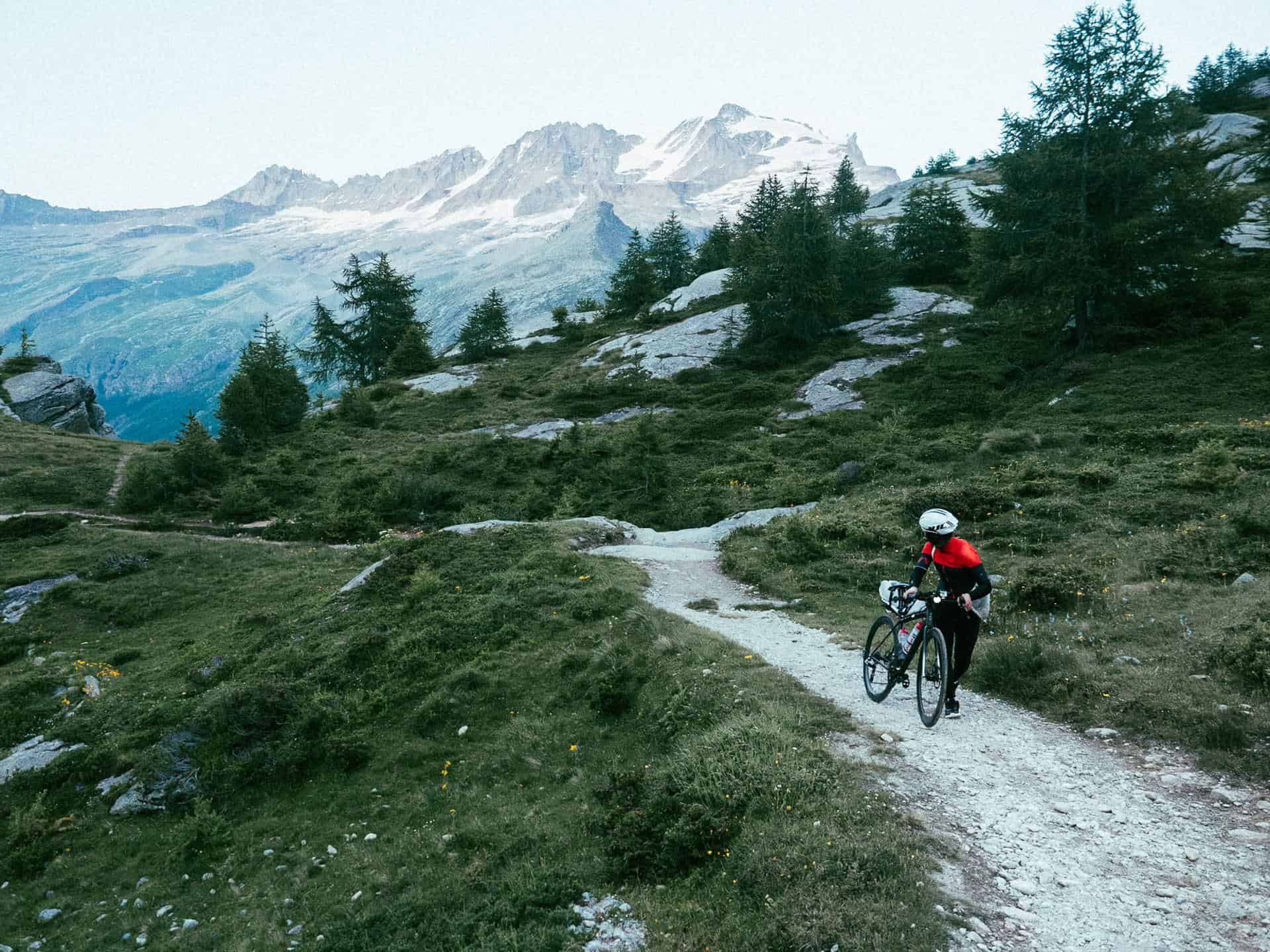
But up there at 2,600m, when Adam climbs towards us on the trail, I freeze. All the debates about ethical support collapse into a very concrete moment. No theory makes any sense. Is it more ethical to hide behind bushes, as Nicky Shaw recently wrote? She refers specifically to FKTs, and I think those strictest rules don’t apply to races. Can I say hello, or would that be undue interference — especially in this very challenging section? What if he falls while replying? As foolish as it sounds now, these were my actual thoughts. Does interacting mean breaking his loneliness and cheering him up, or breaking his focus and making him angry? In short, how the hell should I behave?
If it weren’t for Ryan, I would be lost and would lose precious moments to shoot. When Ryan greets Adam, I do the same. When he gets closer, I get closer. I feel a bit stupid, but I prefer playing it safe until I get more familiar with the whole ultra etiquette. We exchange a few words about the race and his expectations — all very friendly. By then I’m more relaxed: talking is OK for a bit. And it’s essential: we are here to tell stories, and we are thirsty for words.
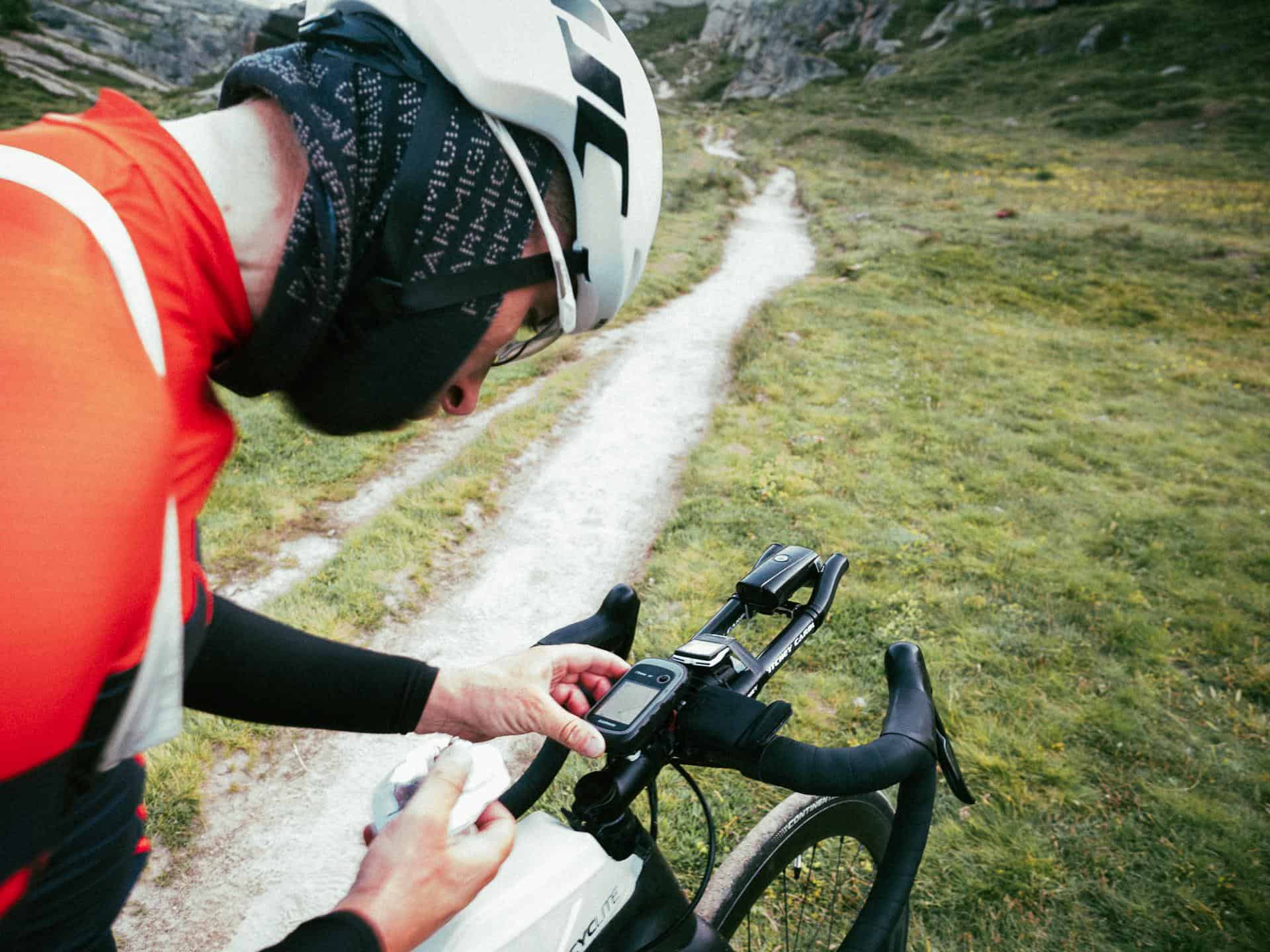
Following him on the trail, we take several shots, then I keep following him to a crossroads. The trail splits and he stops to check the route. I stop abruptly and wait for his choice — picture Wile E. Coyote’s braking screech whenever he sees the Road Runner. He takes right, I go left: he goes for the military road, while I take the single track to get ahead of him. At that moment I clearly feel the weight of my behavior. Does Adam think I know the better trail since I’m a local? Am I giving him clues through body language? Many questions bordering on paranoia.
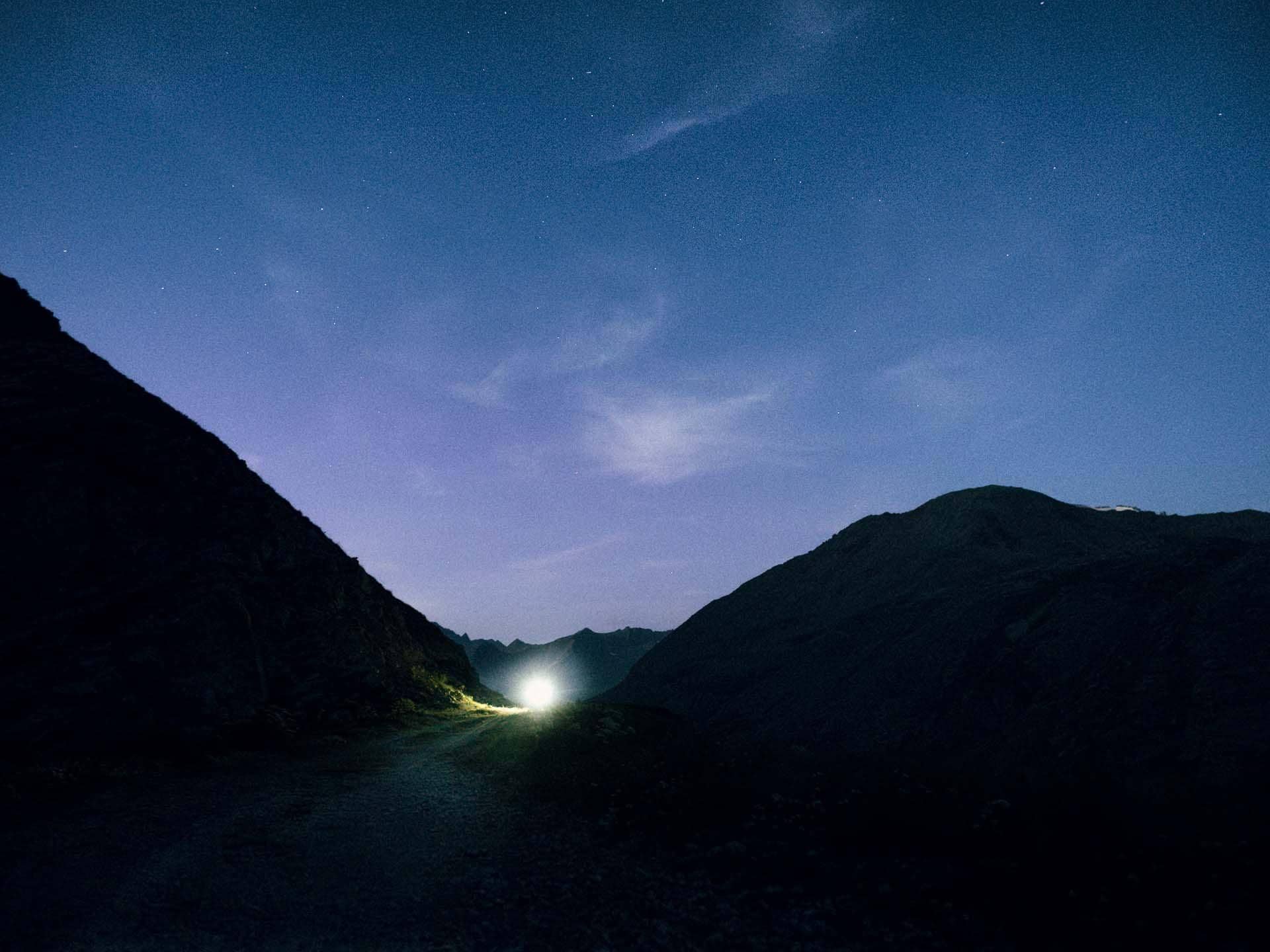
The blue hour is fading into night; walking alone in the darkness, Adam has plenty of time to think and to question his own choices — which wouldn’t happen if I weren’t there. In the dark, we can see each other’s front lights on the two parallel tracks. Influence. Interference.
Usually, you clearly perceive the boost you give to riders when you follow them. You’re the first face they’ve seen in days, and they’re happy to talk and share their journey. Not always, though: sometimes you approach a rider who’s not happy to see you. When it happened to me for the first time, I was surprised — no, I was annoyed — but it’s also very interesting: why is he upset? What’s the story there?
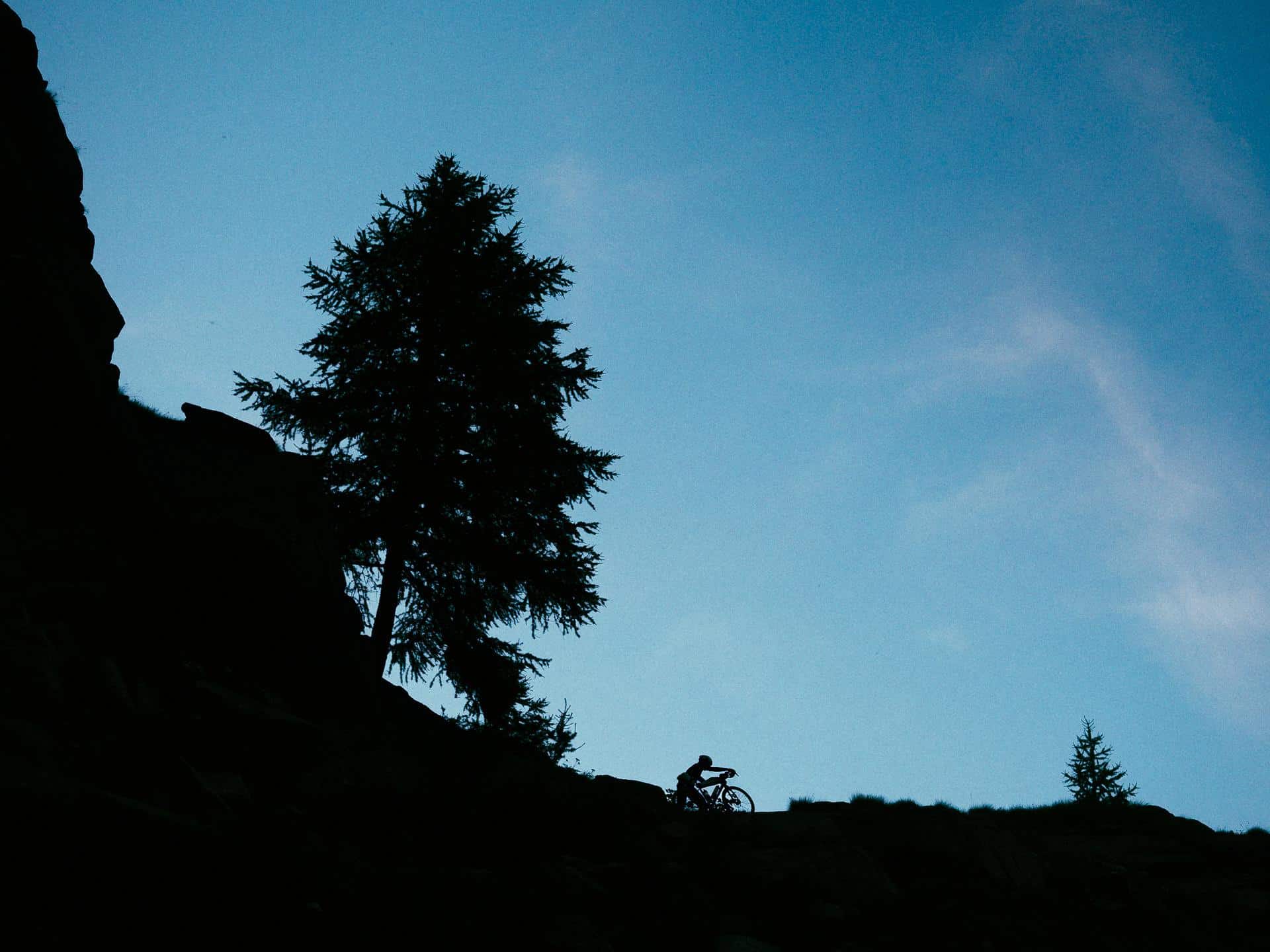
The silver lining to all this is that there’s no real solution. Influence — whether positive or negative — is there from the moment you say hello. You can’t un-influence. So with Adam I stick to my original instinct. I get ahead of him on the single track to wait in the dark, even if this means he can see me passing from his elevated road. A few more shots — little man versus vast landscape, the classic sublime-romantic situation. Then we part ways; it’s late already and pitch black down in the valley. He rides fast to Velodrome Francone, the next refuge.
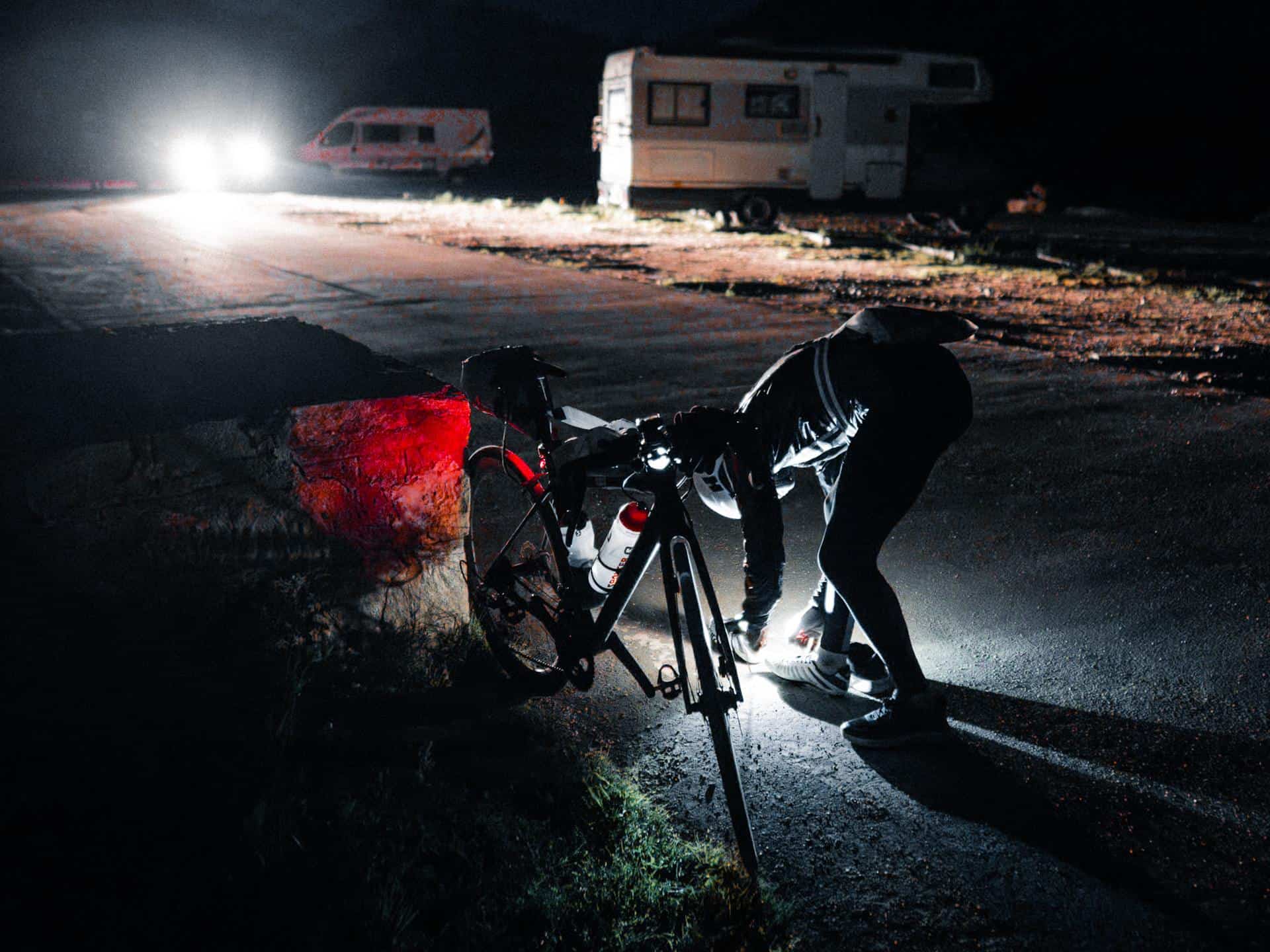
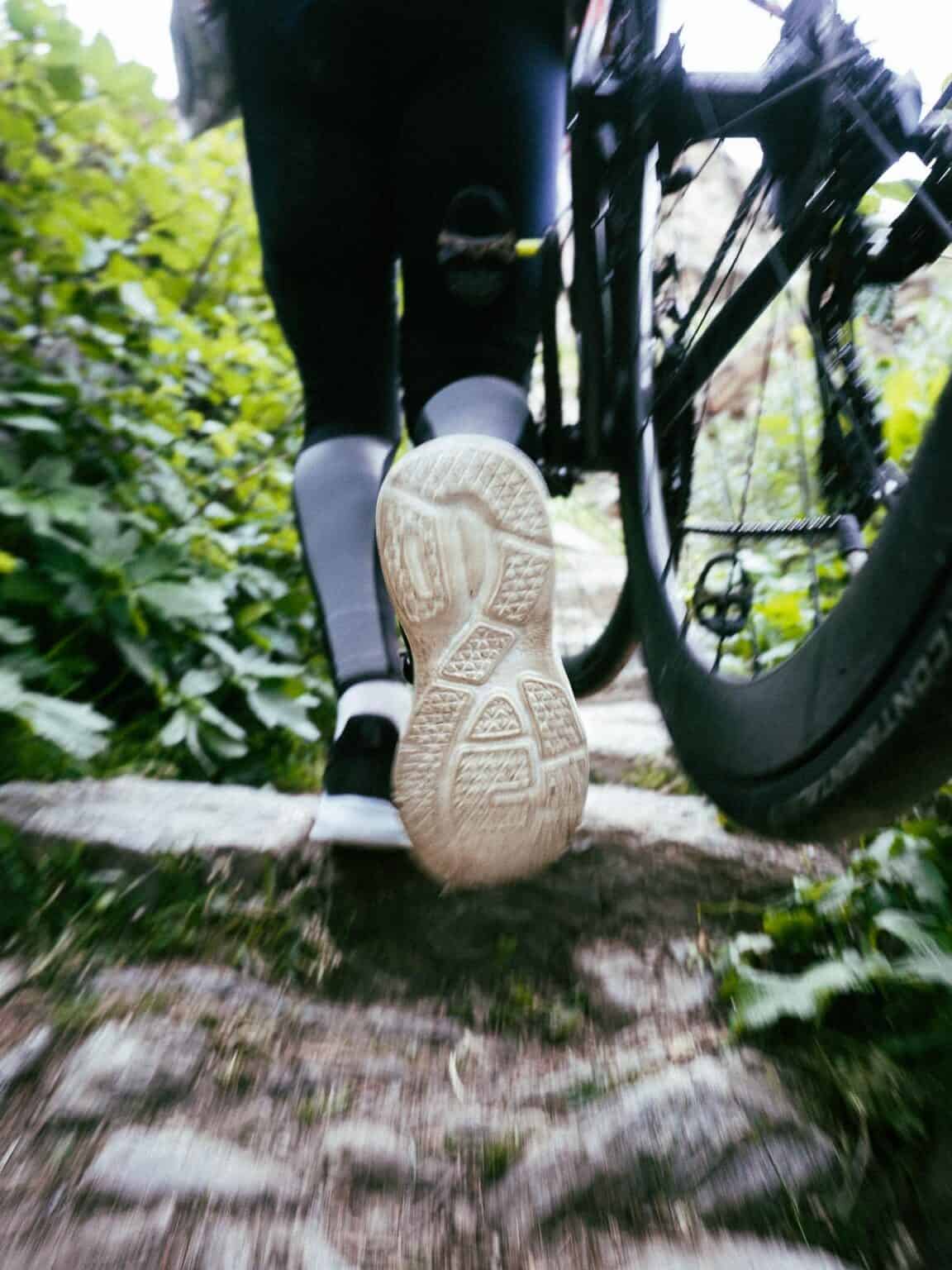
After the race, Adam gives us positive feedback, saying we didn’t bother him that evening. This is comforting. When I send some pictures to the organization immediately after the shoot, two are challenged: “you look like you were too close” — for a shot trying to catch his running shoes on the hike-a-bike — and “your car lights can be considered helping the rider” — when he is swapping shoes in the parking lot.
I have objections. As for the shoe picture, I took it because — wow — the leader is running on rocks during a road race. That is the story. As for the light, we didn’t park the car that way intentionally — we just stopped as quickly as possible. Our car’s lights weren’t nearly enough to help him, and he used his own headlight for the operation. Besides, it could have been any car in the parking lot; I’m persuaded that photography is about plausibility more than it is about literal truth, and other vehicles drove there both before and after Adam stopped.
Still, I take the point. As a media crew, our responsibility around the support we provide riders — positive or negative — is significant. The relationship with riders is unavoidable — that’s literally why we’re here — but it must be managed very carefully.
My personal working solution — still a work in progress — is to think in terms of time and distribution. Our ideal goal would be to cover every rider. Of course this is impossible. But we are a team of photographers and videomakers, each catching a few riders, so our psychological support or interference is spread a bit more equally across the field. More importantly, over time and across different races, this interference will tend to become more democratic: we will catch new riders while missing others, and statistically this will level out our effect. Media coverage tends, asymptotically, toward becoming a public service.
We are present, and our presence will influence riders whether we intend it to or not. So let’s at least try to spread that influence as fairly as possible across the field — knowing that’s nearly impossible within a single race. But since I hope to cover more and more races, and media teams around the world are doing the same, hopefully this “quota of influence/support” will spread fairly across all riders over many years and many races. Time and patience are essential — much like in photography, incidentally.
This is my very personal working principle — or perhaps my self-justification — when I meet riders who are visibly relieved just to see another human being after hours or days alone. I know it’s abstract and somewhat optimistic. Beyond that, it’s a case-by-case judgment that goes well beyond any mechanical application of rules.
I also know it’s a somewhat weak argument, since trusting statistics isn’t a real solution. But it’s the best I’ve found so far. And it is, indirectly, confirmed by what Nelson said about violations of the unsupported rules by riders. Since this is a self-policed discipline, violations are not easy to prove — but if you break the rules systematically, it will eventually come to light. Maybe not the first time, maybe not the second. But once discovered, trust will be destroyed even retroactively.
Another set of questions arises since the race is not always a race.
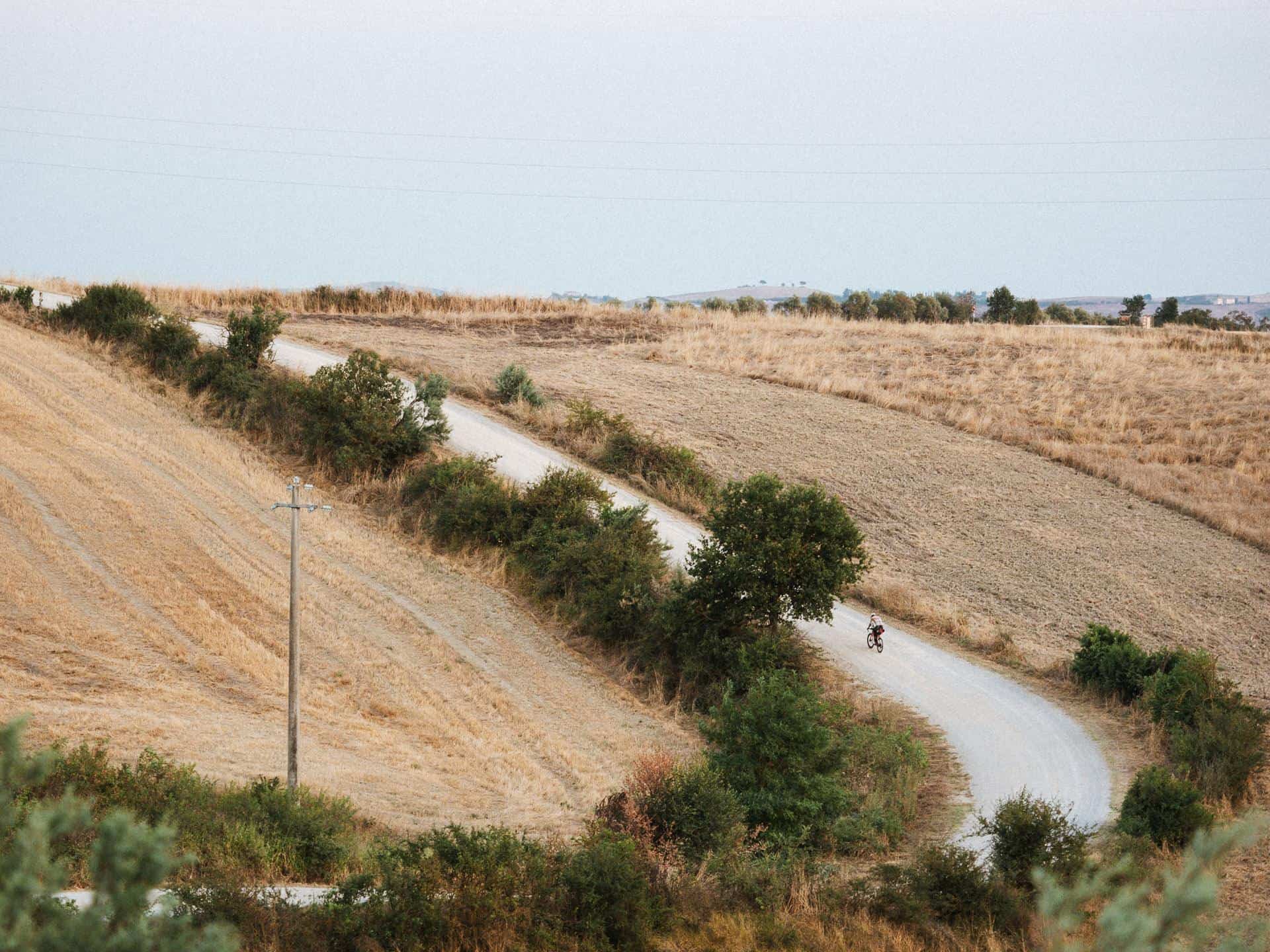
A few days into VIA I, Ryan and I are planning our day to catch Eivind Nordal Gran at sunset on the mandatory gravel section of Strade Bianche. Tuscan landscape, good light, and a cool rider — couldn’t ask for more for the last shoot of the day, just before pizza.
At 8pm we’re in Asciano, at the southern end of the mandatory parcours, and his dot is just entering the section from the north. We know a few spots; in a few minutes we’re set on a curb. The usual wait begins.
Nothing happens.
Our eyes go back and forth from the road to the tracker. The dot isn’t moving. Previous updates were reliable, so something is off. Do we risk our nice spot to approach him in time for the golden hour, or wait in the good spot even if it means shooting in dimmer light? Time is running, but he isn’t. The dot’s last location is in a downhill section. Who stops there? Did he puncture? He’d already be riding again. Did he fall?
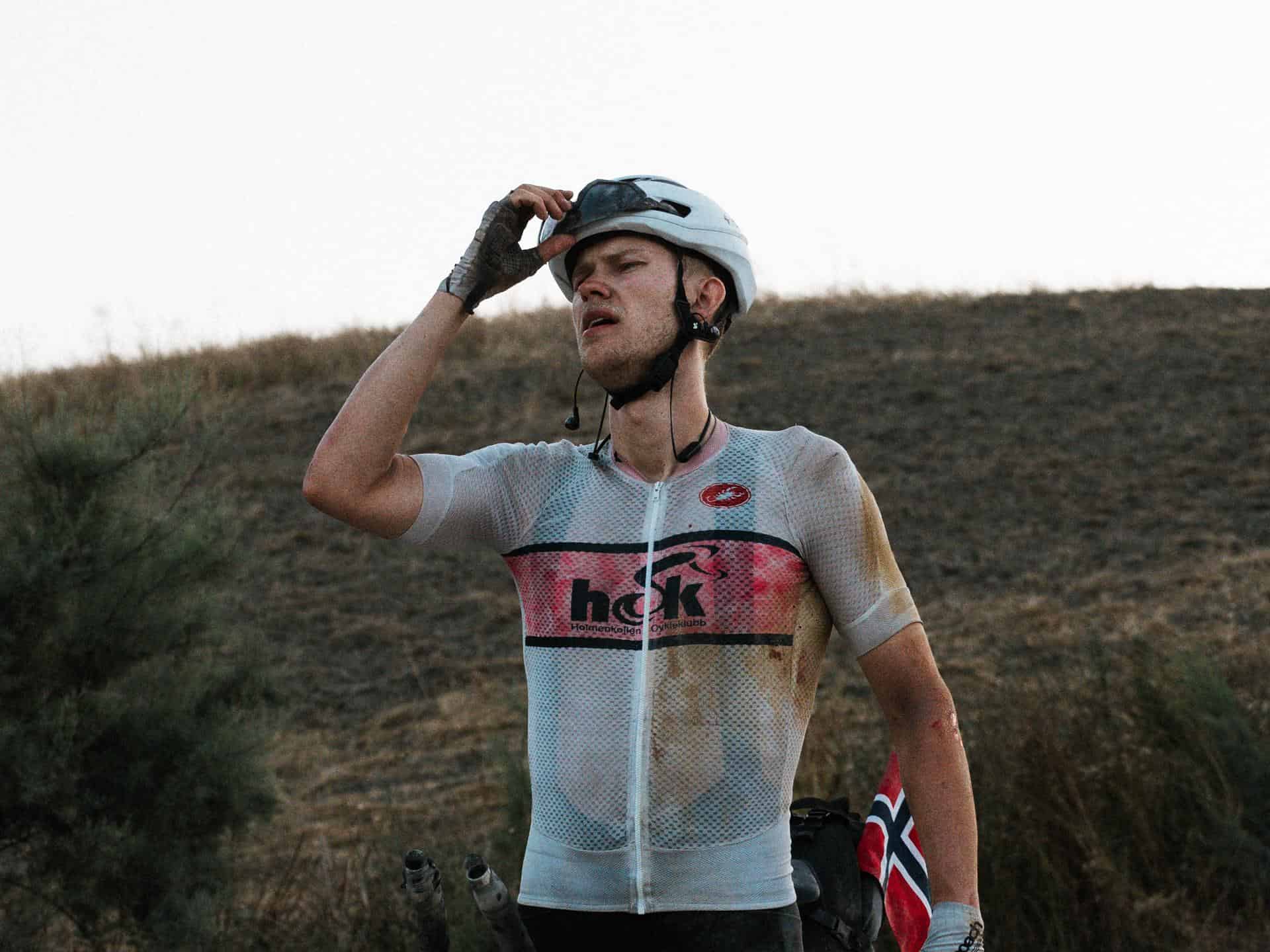
We decide quickly — our gut says to get closer. Some 100 metres further, just behind the crest, we find him recovering from a crash. He is very happy to see us.
We shoot and we approach. And we become an assistance car. Eivind himself asks us to stay with him a little longer, and neither Ryan nor I think for a second about the ethical implications. We assist and shoot. A bit later, he asks us to escort him to the village, where he’ll stop for the night. The words “against the rules” are mentioned at some point, but I can’t remember who said it. The reply is simply, “we’ll see afterwards.” If he needs us to feel safer, we stay.
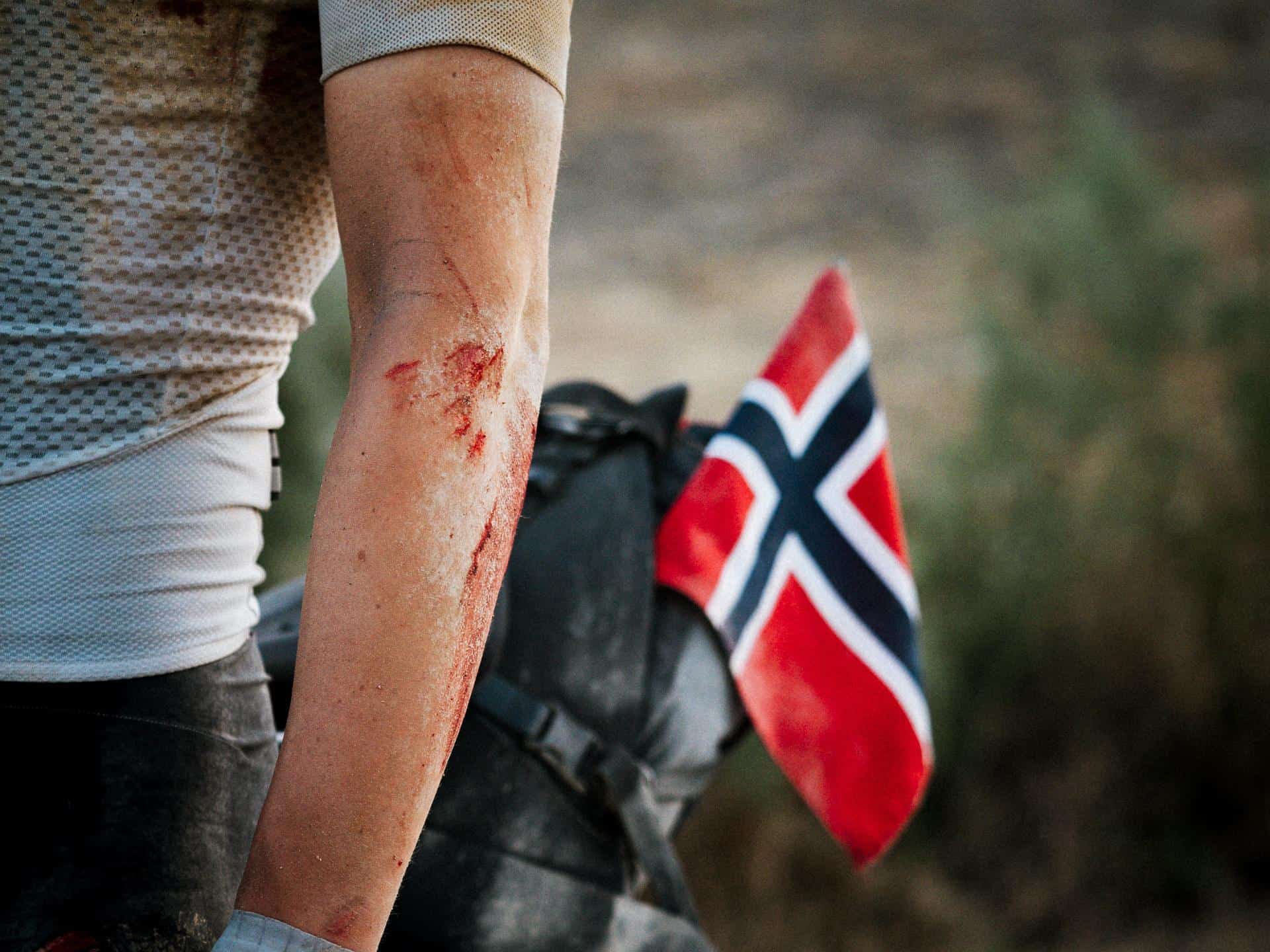
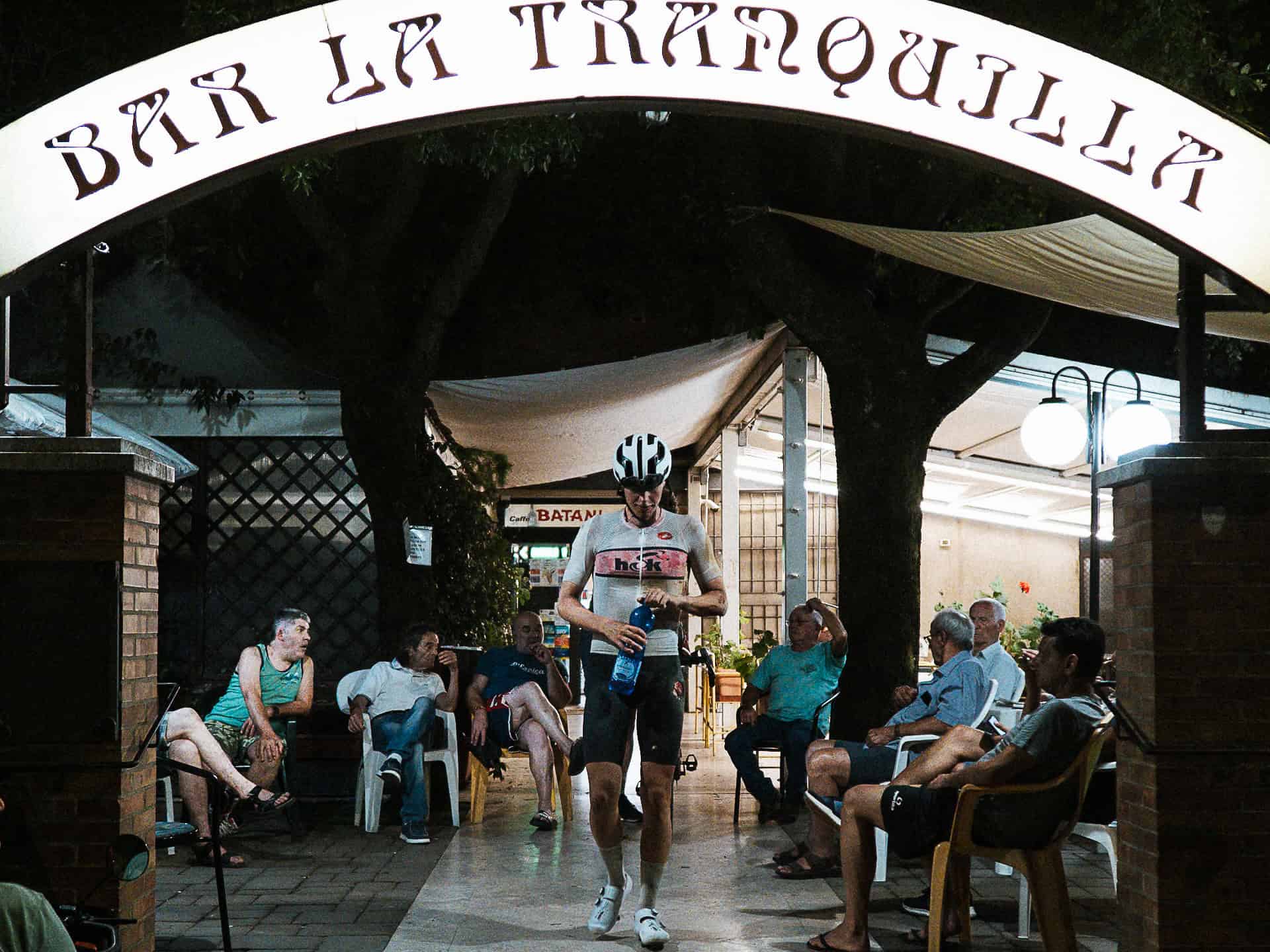
We reach the local bar, where a platoon of retirees enjoys the cool evening. They all turn to look at this strange individual — blood on his legs and arms, pink gravel bike — with curiosity. A friend of his happens to be nearby on holiday; we wait until he arrives.
We clearly supported Eivind. Is that a double standard? If we had left him to his own destiny, he probably wouldn’t have felt betrayed or neglected. But he was enjoying his holiday, and to keep him doing that, helping was the right thing. His ride was about adventure; Adam’s was about winning.
In Italian there’s a saying: due pesi, due misure — two weights, two measures. The same fact in different situations requires different behavior.
After Adam finishes, we learn that he fell twice on the Nivolet hike-a-bike, shortly before our encounter. Of course, had he asked for help, we would have given everything we could. But Adam was racing and didn’t mention the accident until the finish line.
Despite all the theory, it’s easier than expected. Understand what the riders want, and you’ll probably have the answer about the support/interference question. If they’re racing — regardless of their position — you’ll know it; usually you already know it beforehand. If they’re cruising, you’ll have more room. Adam looked for pizza because it’s everywhere and it’s fast. Eivind looked for pizza — even four a day — because it’s delicious. Why should the rules be the same?
There’s another reason to justify assistance, one coming from my sailing background. I see ultracycling as very similar to solitary sailing: it’s an intrinsically adventurous discipline, and the main challenge is against a hostile environment, not against other riders. When somebody is in distress, you help. History offers countless examples of this romantic solidarity at sea. When Isabelle Autissier capsized in 1999 during the Around Alone race, Giovanni Soldini — then in third place — didn’t hesitate a second. He changed his route, sailed straight into the depression that had caused Isabelle’s accident, and saved her. Then he won the race. Even though he was no longer alone on his boat, the judges awarded him the victory, ignoring the feeble protests about the rules.
At sea, this principle is so deeply acknowledged that even wartime enemies must rescue each other — and they usually do. Lowell Thomas’ Raiders of the Deep is all about that. When you’re in a hostile environment, community always comes before competition. So, with all due proportion, why shouldn’t the same principle apply to the extreme adventures of ultracycling?
It does. When a car hit Nicky Shaw at night near Valladolid, not only did support cars come to her rescue, but four riders converged to help as well.
In the end, there’s no clear-cut rule. From the moment you meet a rider, you can’t un-influence. The situation is different because of me, because of us. We must be honest about that. The only thing we can do is try to cover as many riders as possible, to dilute this influence.
The following morning, Eivind announces his scratch. He could keep pushing, he says, but it wouldn’t be fun to ride with bandages in the heat. He will recover in Florence and join us at the finish party in Giovinazzo. Weeks later, I ask if he scratched partly because he had accepted outside support:
“I didn’t think about that. I didn’t care about the race.”
The shoot with Eivind was one of the most intense of the whole chapter I, it goes without saying. This was because I didn’t know what would happen in chapter II.
Anyway, my take from these episodes is that it’s nice to tell the story of a winner, but it’s far more interesting to tell the story of solidarity and unexpected companionship, and to dig into one rider’s perspective to understand his/her own story – what brings this rider here.
Short stories from the field: people, places, and cemeteries, with some reflections on all this.
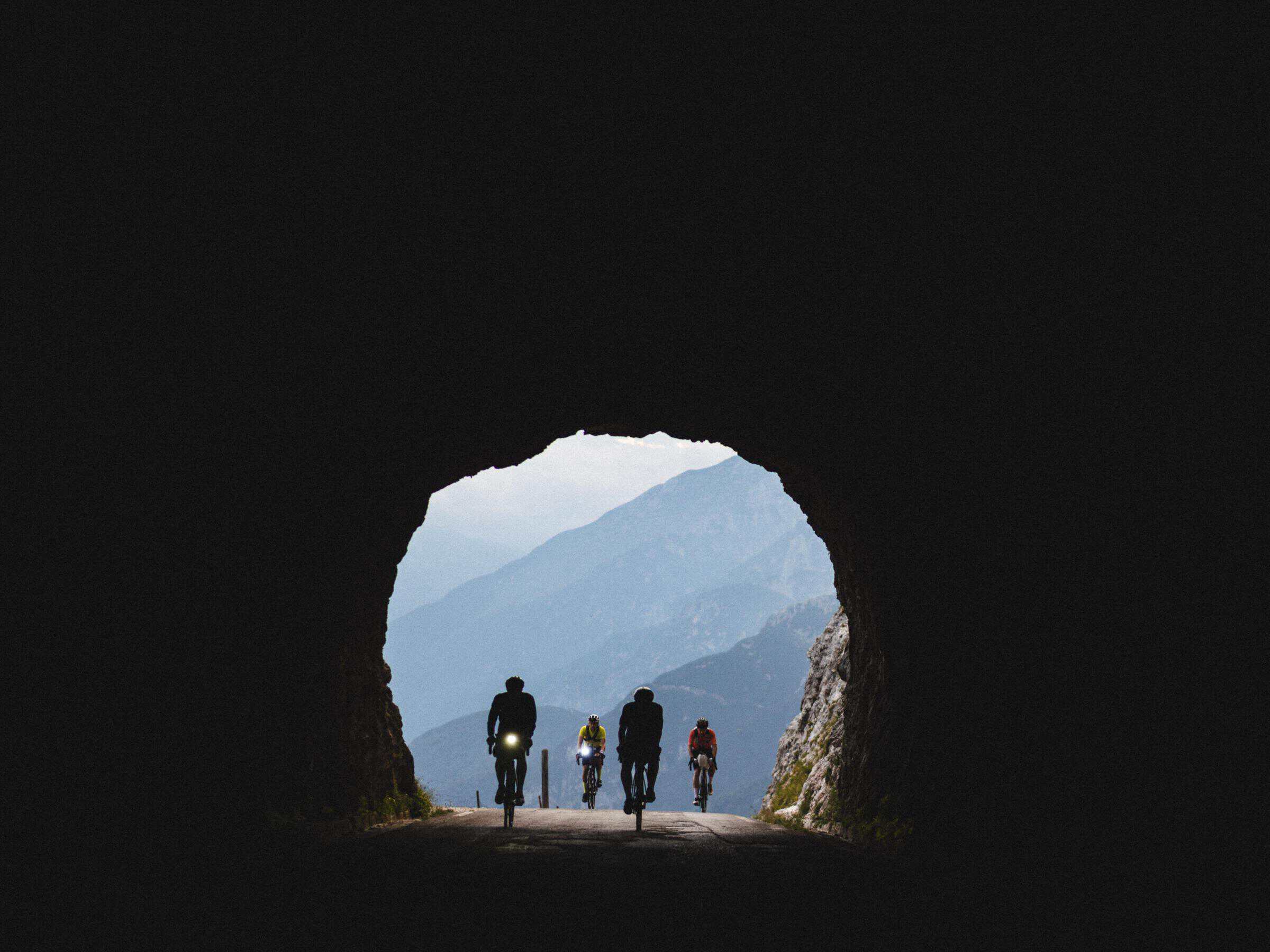
How do you actually find riders, and what do you do when you find them?
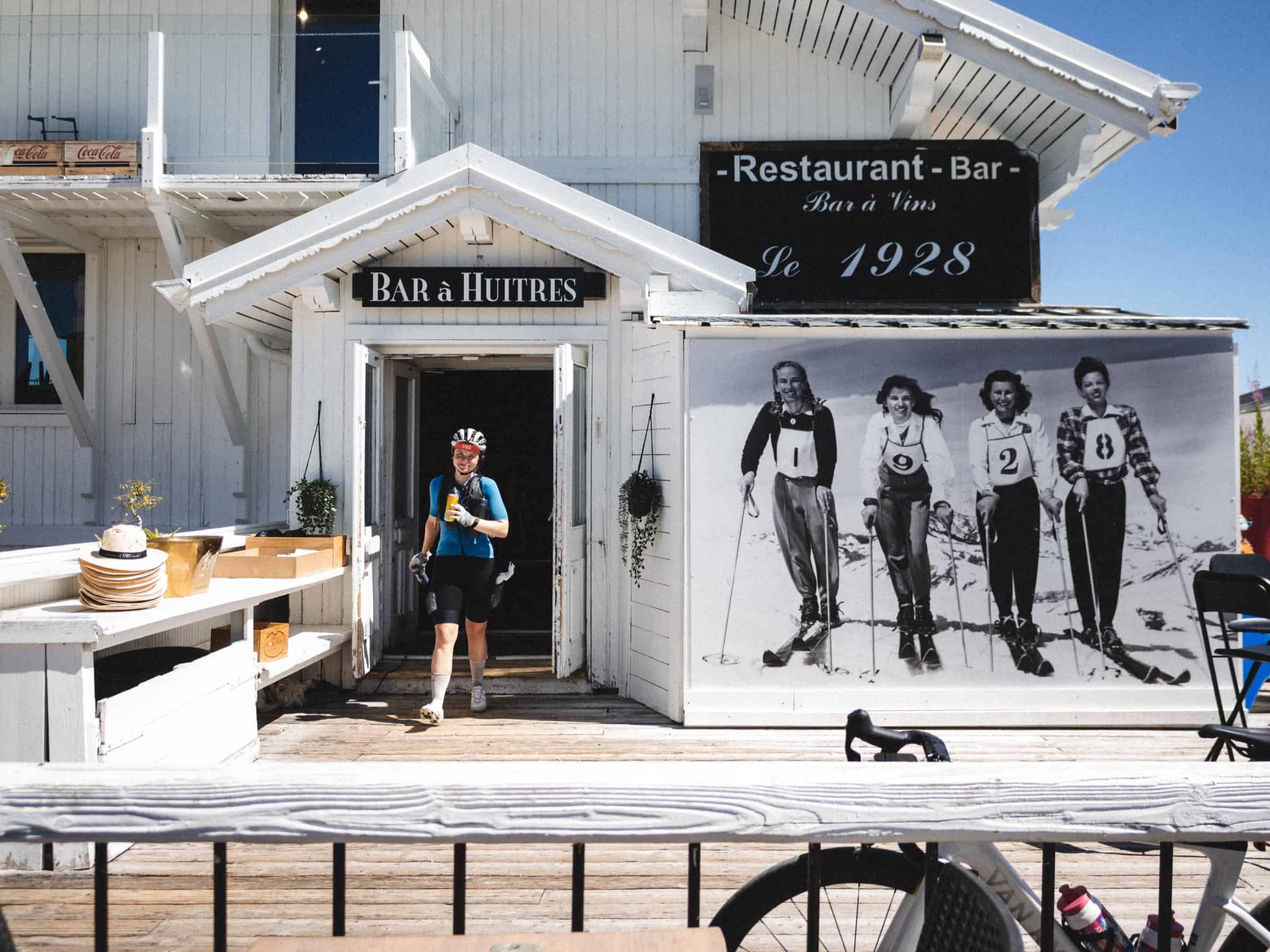
How do you choose to shoot when every rider is doing something, all over the place?