Alternative Altitude Alps, 2026

Being close yet invisible: a micro 4/3 perk

Things that diminish interfering and influence risk

The ambition of being invisible is always strong when covering an event. During an ultra it is also a matter of ethics: as we discussed already, being discreet is key to reducing interference with the riders. 

A clarification, though: the interference I mean here is not the same as the one I wrote about in the two parts on unsupported races. It is not about influencing the outcome of a race by giving a “moral support” by the presence of the media crew, something that is pretty reassuring. Interference/influence here concerns the photography, not the race. It’s about changing how people behave because a camera is pointed at them. The observer effect, if you like.

Luigi climbing on the Finestre. It'sabout to be a crazy ride.

The tension between participant and invisible?

On an FKT attempt, according to Nicky Shaw’s recent guidelines, the media crew should indeed be invisible, hiding in the bushes if needed, to rule out any risk of influencing the athlete: Beyond the material “no support provided”, she recommends also “no interaction with the rider”, which include talking; and “quietly retreating behind a hedge when the rider arrives sooner than expected”. To sum it up, we read, media crew should master “the art of being present without becoming noticeable”. 

However, reportage also requires being close, being part of the scene we are documenting. Participant observation, would say any ethnographer. Staying far away wouldn’t be fair, to the story or to the people in it. So there is a bit of a cul-de-sac: 

how do you be close and invisible at the same time?

Invisibility is rarely on offer in cycling events outside the specific FKT context. What we can aim for is a presence that doesn’t feel threatening, and becomes virtually invisible. A long tele gives you distance, but it also takes you out of the scene you are supposed to be part of. A small lens keeps you inside it without alarming anyone.

Breaking barriers (faster)

Over time, and this is something I only started noticing in this last couple years, I realized that micro 4/3 is a valuable asset against this problem, if not a solution to it. It sounds silly, but people react differently when you work around them with a small lens or with a big one. It is probably natural. 

If you already know the people, the difference is much smaller, or absent. But with “cold” subjects it makes a big difference: the first time you meet them in a race, or the first day, when reserve and modesty are still strong in the riders, there isn’t yet the confidence: that needs a couple days to grow. In a sense, the small kit buys you the first day.

On some occasions I really felt this bonus, thanks to the tiny lenses mounted on my OM-1 II (which is not a particularly small camera). Two recent examples in basecamps, where this is very visible: 

Backyard Gravel Bodensee, May 2026

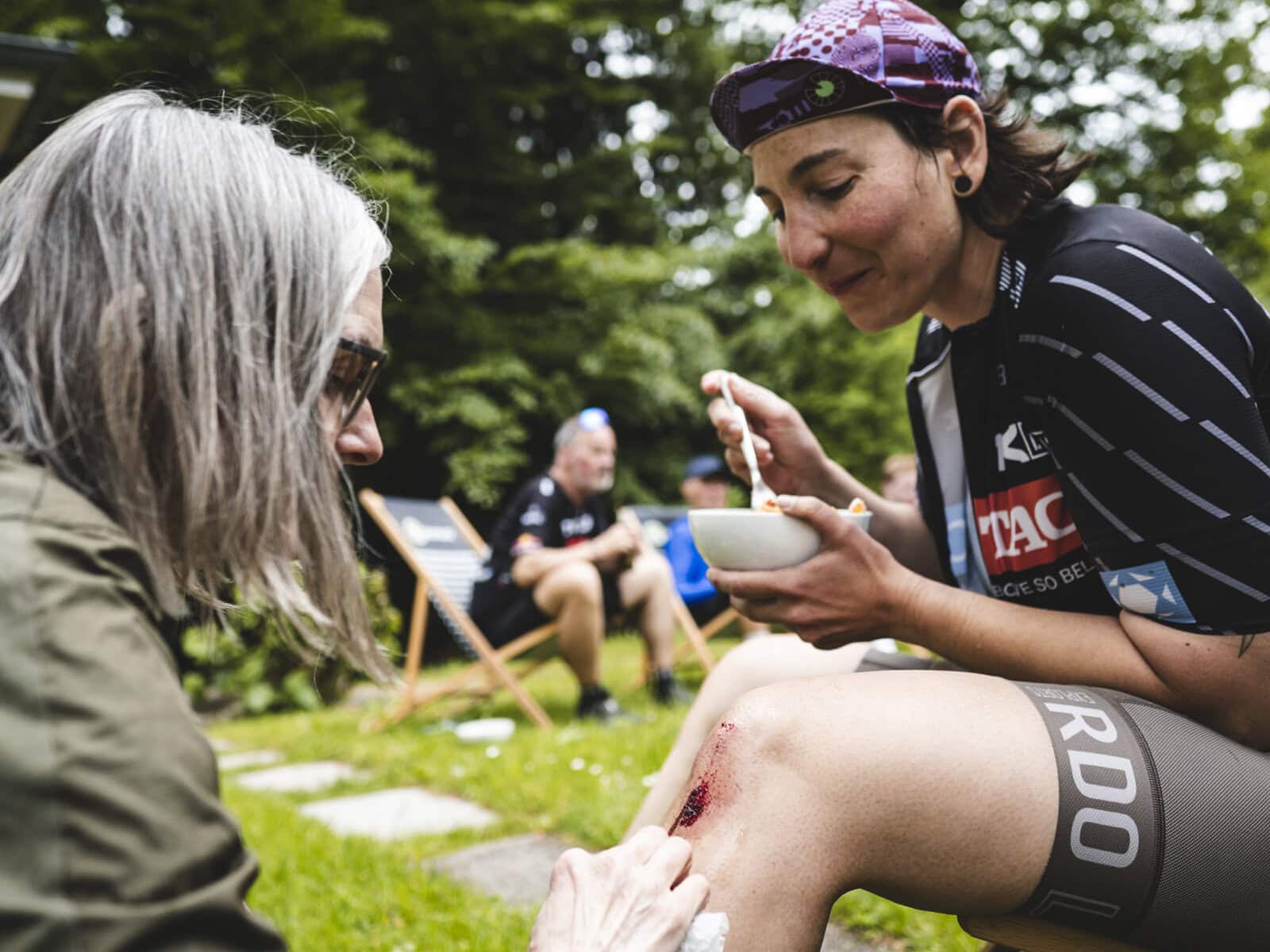
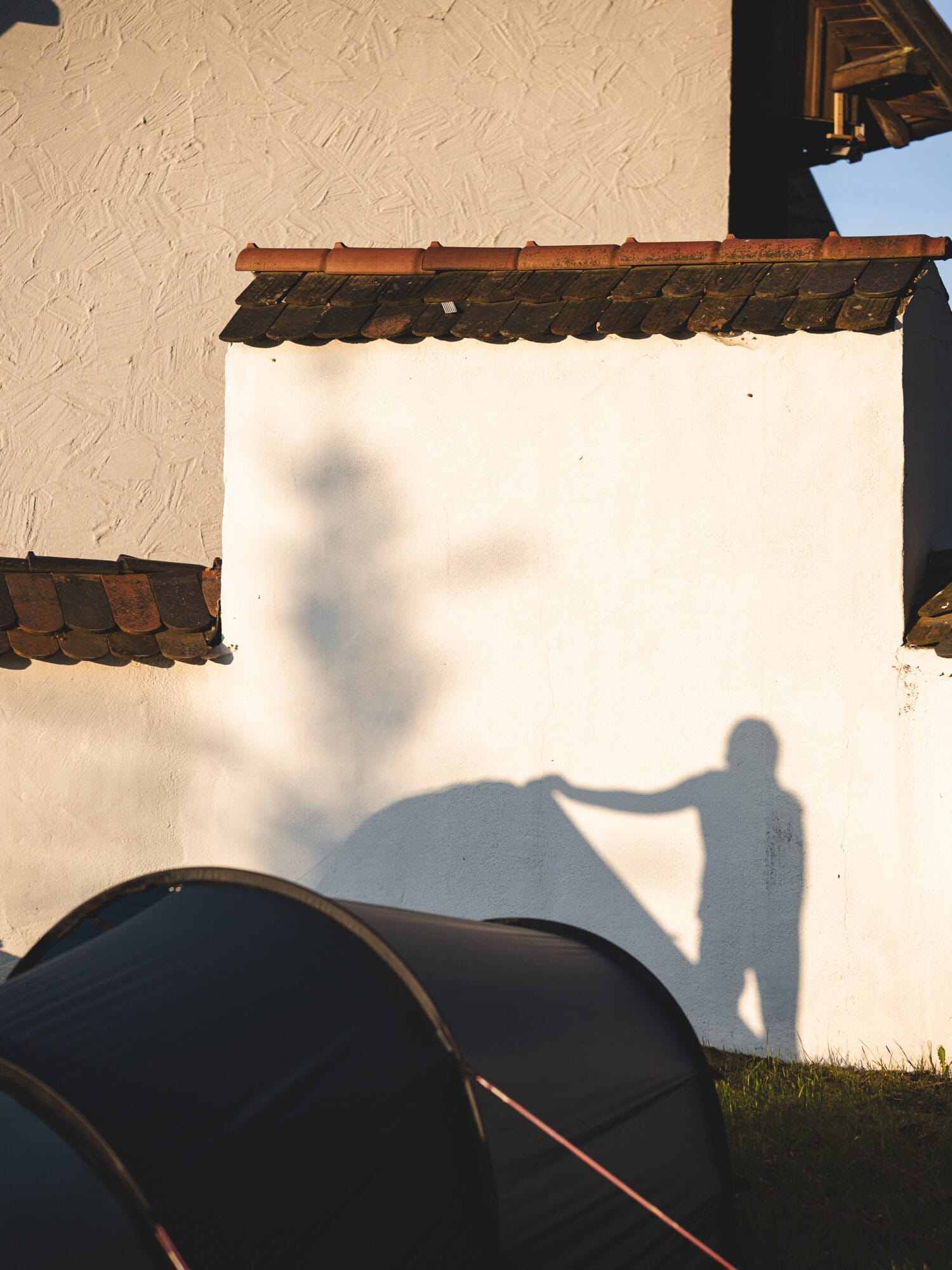
First, the riding reportage of Backyard Gravel Bodensee, last May. First night at a ski station, second night in a former hospital, both nights tents and sleeping mats. Of course my job involves going to sleep after people and waking up earlier, to capture the most interesting moments in the most promising light. 

Here I had my favorite lens, the 17mm 1.2, (35mm equivalent). it’s 300 grams and as big as a Fanta can: unobtrusive,almost invisible. We knew each other with several people from previous events, so this helped further; still, walking around with my small camera, people didn’t perceive me as “predatory” as if I had paparazzi-like equipment. Yet I was silently sneaking behind tents in the dark, which could easily be perceived… not very well.

Of course the gear is not the only element at play here: there is also the attitude, a blend of being kind, being discrete, and being mimetic; there is the fact that we knew each other (even though not everyone); there is the fact that I was riding all day with the group, so yes I was “the photographer”, but I also was “a rider” part of the bunch. 

Riding while shooting – Beyond more original photographs, taken in motion, it brings down the wall between subject and photographer at once. You are one of them, dirty and sweaty, sharing everything from the start. This whole “riding reportage” deserves its own piece, soon to be published. 

Piemontgravel 2026

Second occasion, where I didn’t know anybody, and I was working with a car – no empathy developed during the long ride – and with Gabriele, videomaker colleague: riders would see us popping by in random moments of their day, no fatigue at all (at least not the one provided by riding), no dusty clothes; and not only one person but two. Establishing the necessary confidence was much harder compared to Backyard Gravel, but still. 

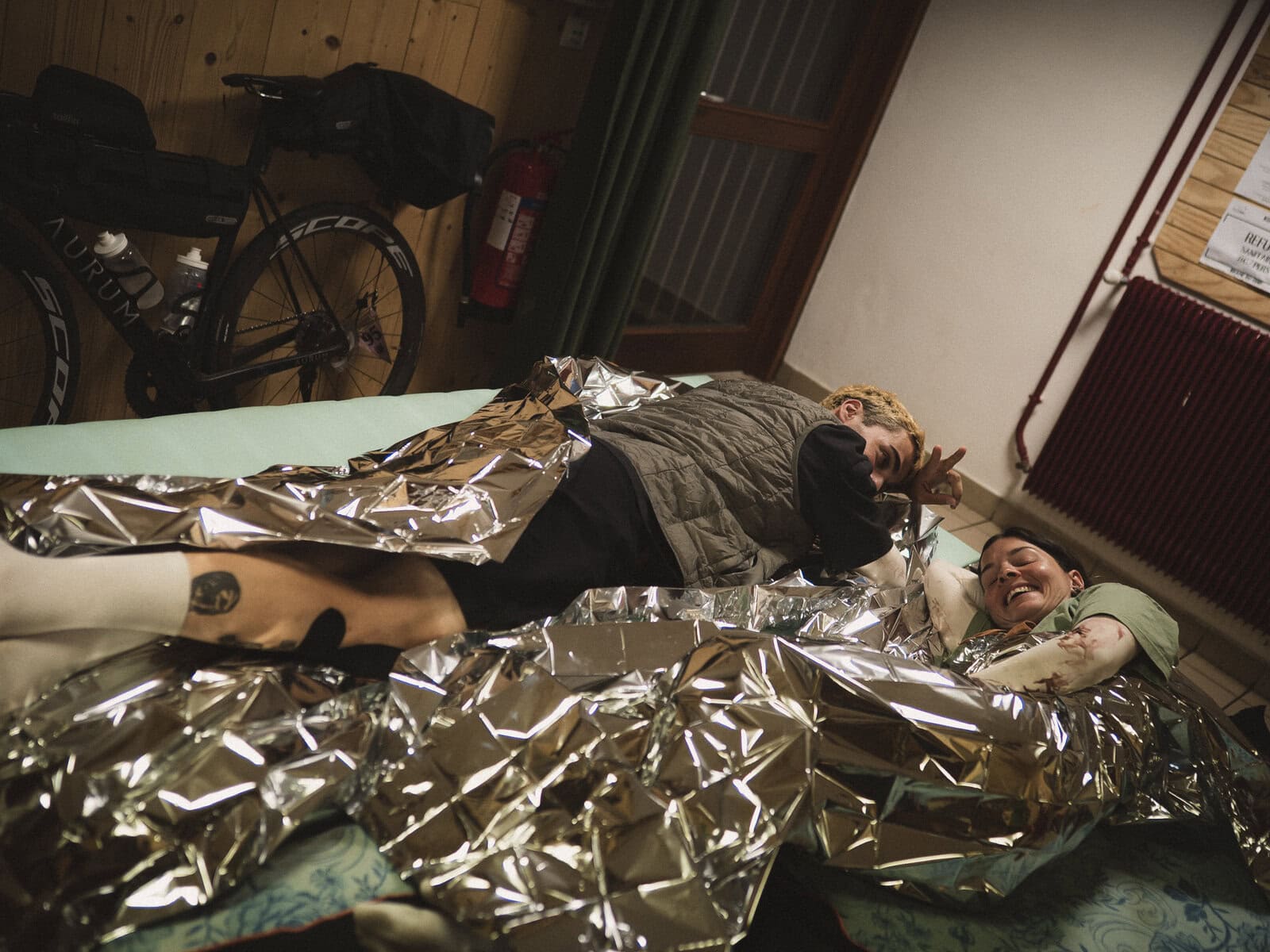
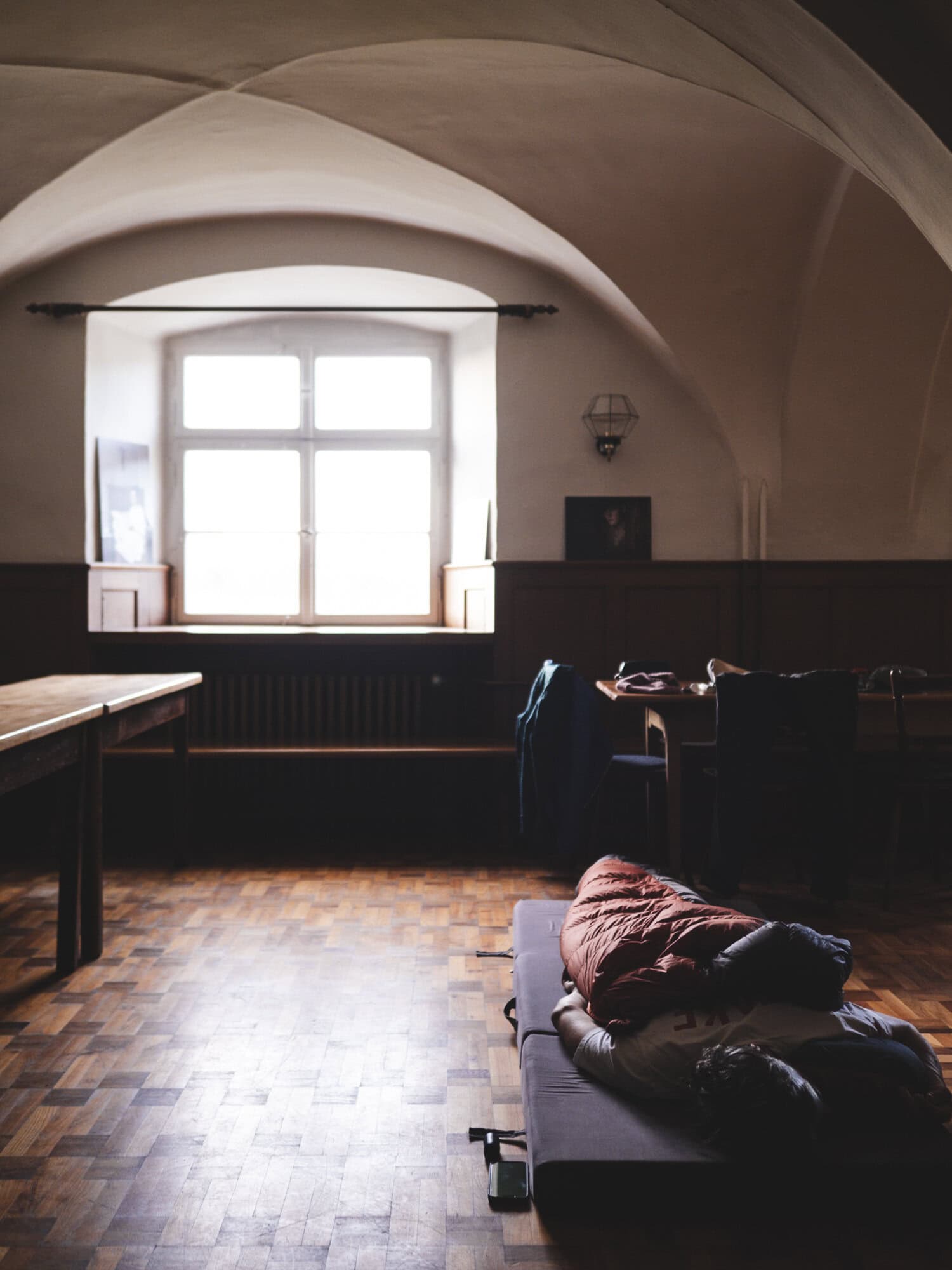
We stopped at the second basecamp, a beautiful modern building with a large sleeping room. We prepared our sleeping mats in the middle of people, with our gear backpacks instead of the bike gear. And we documented the whole “going to sleep” PROCEDURA: inflating stuff, changing clothes, brushing teeth, checking equipment, and so on. 

We documented everything, from very close, wandering in the dark room trying to not walk over somebody. Again, my 17mm and 45mm helped me in being discrete. Most riders would look at the lens and register that as “innocuous”, without posing, often without even reacting.  

EVOC hip pack review
Read
Elective affinities pt.2: micro 4/3 for cycling photography
Read
Alternative Altitude Alps: a multi-days bikepacking route
Read

It is worth being clear that it is the lens that does most of the work. the Om1-II is more or less the same size as any average full-frame, but micro 4/3 sensor lets you build small lenses; put a big tele on the same camera and the bonus is gone. Put a standard 24-70 2.8 full frame lens, and the unaware subject will be slightly intimidated at least at first sight. Which could be your only sight, so the advantage of using it properly is not negligible.

The recent OM PEN could improve further this discretion, I guess: lighter, smaller, as it is loved by street photographers. 

Kids

The benefit of “small” extends to the rest of the kit. My EVOC hip pack is much less invasive than the classic camera backpack: it makes you look like a casual guy with a camera. Which, in this context, is exactly the point. 


Kids are a similar but not identical case. They are curious, but not uneasy in front of a small camera the way they would be in front of a big one, and here knowing each other changes little, at least in my experience. The mechanism is different, though: with kids it is curiosity, with adults it is reserve. 
 

Objections and counterexamples

Bigger cameras and intimate photography: Tina

Does small always give you this advantage? Of course not, it’s not a mathematical proportion. There are many counter-examples showing that intimate photographs can be made with enormous equipment too. Meyerowitz – we recently talked about him while we discussed the “intention” subject – did street photography with a view camera (indeed, he shifted from proper candid street to a more architectural/evocative style, pushed by the new equipment).

Tina Barney is even more interesting for our topic: she shoot “theather of Manners” mainly indoor with a large format view camera, with 20x25cm films: in order to achieve this level of intimacy with such a large tool, she was part of that community and she spent a lot of time before each shot. She possibly placed the tripod and the camera and then left it in place, so that it would become invisible to the family. Only then she would shoot. An interesting video about her, by Michael Bertolasi (in Italian), is here.

So a small kit is a shortcut, an alternative to having a lot of time. At an event, where you rarely have days, the shortcut is often the only one on offer.

Smaller cameras and intimate photography: The smartphone

There is one more obvious observation: if smaller is better, than a phone is even less threatening than any small camera. I will write elsewhere why I don’t like shoot with my phone. 

Yet, if you ever tried, you probably noticed that it’s not really the case: the phone at close distance makes people uncomfortable, possibly because of its features: you snap, you post, it’s public. So the person views it – and with cause – as threatening. A camera, you have to download, process, think about it, so you have time to judge the decency of the thing. 

In the end

Generally speaking, a camera that people stop noticing is a camera that people stop thinking about, and at that point the consent is no longer theirs to give: it is mine to keep. This opens to a whole new discussion, one that we only partially covered in the Ultrashooting series and its ethical implications.

To sum up, the discretion bonus of smaller gear is real. The point is to use it to get closer, not to take what was never offered.

More thoughts on Stories and tellers

More thoughts on Stories and tellers

Get in touch!

Improve your cycling photography!

Subscribe to Fotogramma, the monthly newsletter about cycling photography: stories, tips, and techniques. 

Or, simply explore the blog!

Scroll to top